Applying Behavioural Science to Mitigate, Adapt, and Build Resilience Against Climate Change.
The Centre for Social and Behaviour Change (CSBC) applies behavioural science to promote sustainable practices that reduce carbon footprints, support climate adaptation, and build resilience. By addressing both demand-side and supply-side barriers and facilitators, CSBC develops solutions that support positive environmental and societal change
CSBC’s work focuses on four critical areas: mobility, energy, food, and waste segregation, while also expanding into other climate-relevant domains. By applying behavioural science, CSBC identifies and addresses barriers and enablers to promote sustainable choices and support climate mitigation, adaptation, and resilience for a low-carbon future.
How We Move
Mobility
Mobility in India is marked by rapid urbanisation, growing private vehicle ownership, and overburdened public transport systems. Social status often influences travel mode choices, with walking, cycling, and buses seen as less desirable. Congestion, pollution, and last-mile connectivity remain persistent challenges, especially in expanding cities and semi-urban regions.
Problem Statement
How can commuters be encouraged to cycle for short distance trips (<7.5 km)?
SEE LESS
Behavioural Barriers
Cycling as a Recreational Activity
Cycling is perceived solely as a recreational activity not as a viable option for commuting or running errands. This functional fixedness limits its use for daily travel.
Key insight 01
from the report
Lorem ipsum dolor sit amet, consectetur adipiscing elit, sed do eiusmod tempor incididunt ut labore et dolore magna aliqua. Ut enim ad minim veniam.
Food consumption in India is diverse, shaped by cultural, regional, and economic factors. Urban diets increasingly feature processed foods, while rural diets rely more on staples. Food waste occurs across the supply chain, from production to consumption. The environmental impact of rising meat and dairy consumption is becoming more significant.
Problem Statement
How can interventions effectively promote a shift towards sustainable and healthy food consumption habits among high-income urban households in India?
SEE MORE
Behavioural Pathways
Insight 01 – 03:
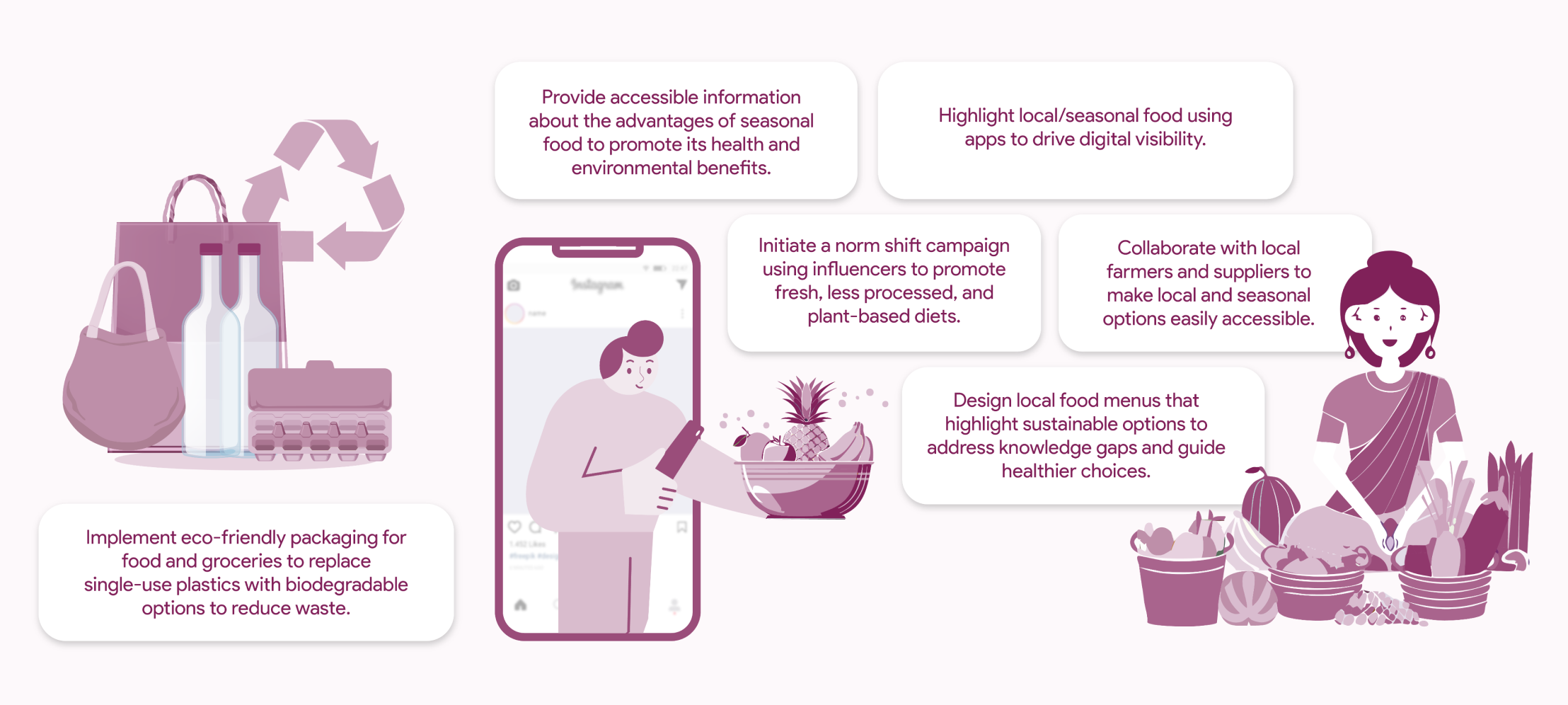
To encourage sustainable food choices, strategies should:
Address cultural sensitivities around plant-based diets.
Educate on sustainable food terminology.
Leverage health concerns as a motivator.
Counter the status-driven consumption of unhealthy options.
Address cultural sensitivities around plant-based diets.
Educate on sustainable food terminology.
Leverage health concerns as a motivator.
India contributes 6.3% of global food-related GHG emissions, with numbers rising.
India’s energy landscape includes a mix of traditional and modern sources. Households rely heavily on electricity for lighting and appliances, though adoption of energy-efficient technologies remains uneven. Rooftop solar is gaining interest, but accessibility varies. Rural and urban disparities in energy access and consumption patterns reflect broader developmental divides.
Problem Statement
How can middle- and high-income urban households in India be encouraged to adopt energy-efficient 5-star rated ACs, optimise their usage settings, and maintain their ACs regularly to reduce carbon emissions?
SEE MORE
Behavioural Barriers
Low Awareness
Low awareness of star ratings’ link to energy and environmental benefits
Perception That 5-Star ACs Aren’t Worth the Price
5-star ACs seen as overpriced, with no added performance
High Upfront Costs
High upfront costs deter adoption
Limited Sales Communication
Limited sales communication on 5-star AC value
Misconceptions About AC Usage
Common to set below 24°C, increasing energy use
Low Awareness of Proper Maintenance
Annual servicing seen as enough, with low awareness of biannual maintenance.
Pilot 1: Encouraging Energy efficient Behaviour in Air Conditioner Usage
This pilot used behavioural nudges like remote stickers and WhatsApp campaigns to shift air conditioner settings to 24°C, reducing electricity use and promoting sustainable habits in 588 households in Mira-Bhayandar, Maharashtra.
How can middle- and high-income households in urban India be encouraged to purchase and install rooftop solar panels to promote low-carbon energy consumption and benefit from long-term cost savings?
SEE MORE
Behavioural Barriers
Limited Understanding
Limited understanding of benefits and functioning (e.g., effectiveness in winter/monsoon, risk of blackouts)
High Upfront Costs
Initial investment deters adoption; access to financing is unclear
Uncertainty About Repair, Maintenance, and Performance
Concerns about performance, repair, and warranties
Pilot 1: Encouraging Energy-Efficient Behaviours in Air Conditioner Usage
At vero eos et accusamus et iusto odio dignissimos ducimus qui blanditiis praesentium voluptatum deleniti atque corrupti quos dolores et quas molestias excepturi sint occaecati cupiditate non provident, similique sunt in culpa qui officia deserunt mollitia anim.
How can nudges motivate households to reduce electricity consumption?
SEE MORE
Behavioural Barriers
Electricity-Saving Behaviours Seen as High-Effort
Actions like turning off appliances are often perceived as high-effort. Habit inertia and the convenience of leaving appliances on lead to excessive energy use and higher emissions (Karlin et al., 2012).
Lack of Awareness About Household Energy Use
Consumers often lack understanding of their energy usage, as bills focus on cost rather than consumption or appliance-specific energy use. Providing this information in a clear, jargon-free format could motivate adoption of energy-saving behaviours (Joshi & Sen, 2021; Salamon, 2017).
Behavioural Pathways
Pilot 1: Encouraging Energy-Efficient Behaviours in Air Conditioner Usage
At vero eos et accusamus et iusto odio dignissimos ducimus qui blanditiis praesentium voluptatum deleniti atque corrupti quos dolores et quas molestias excepturi sint occaecati cupiditate non provident, similique sunt in culpa qui officia deserunt mollitia anim.
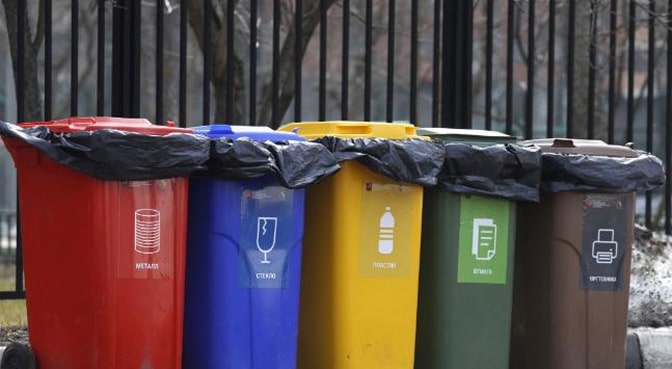
Waste segregation in India faces knowledge gaps, perceived effort, and diffused responsibility. Accessible guidelines, highlighting benefits, and recycling information are needed. Composting and reuse interest exists. localised goals and visible outcomes can motivate change towards a circular economy.
Problem Statement
How can households be encouraged to segregate waste at home?
SEE MORE
Behavioural Barriers
Lack of Awareness and Education
Many households lack clarity on how to segregate waste and what qualifies as wet vs dry waste, limiting adoption.
High Effort vs Unknown Payoff
Perceived cognitive load with unclear benefits reduces motivation.
Status Quo Bias
Existing disposal habits are hard to break.
Time Constraints
Busy routines and lack of convenient infrastructure make segregation difficult.
Pilot 1: Improving Waste Segregation through Simplified Communication
In this pilot, confusing waste labels like ‘wet’ and ‘dry’ were replaced with intuitive terms like ‘Kitchen & Garden Waste’ and 'Other Waste,' helping over 1,500 households in Mira-Bhayandar adopt better waste segregation practices.
Pilot 2: Enhancing Waste Segregation at Windlass River Valley through Behavioural Interventions
This intervention focused on empowering local “Active Citizens” and setting achievable short-term goals. As a result, waste segregation rates surged from 10% to 70% within eight weeks, showcasing the effectiveness of social proof and community-driven action.